
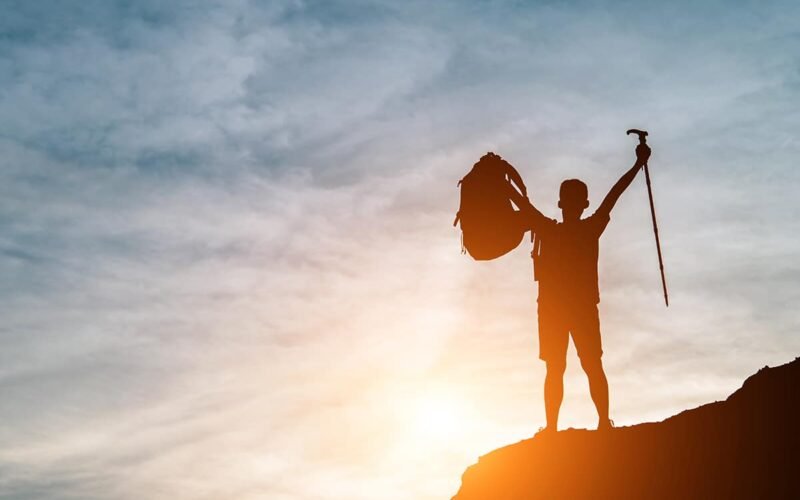
Fun, as you might imagine, was not how I would describe this adventure. Awesome? Yes. Fun? No. N.O. No way. But would I do it again? If I could rewind to that moment when the alarm went off at 4:30 a.m. to throw on clothes, grab our packs and trek up that mountain, would I? You bet your buttons I would. Here’s lives at the intersection of fun and scary. One of my companions summed the whole experience up perfectly. He leaned back in his chair at dinner that night, shrimp taco in hand, “These are the kinds of experiences that give something back to you. They show you who you are in a whole new way.”
These eight shots crystallize the hard work moms put into keeping their kids alive, happy, and healthy. They might give you the inspiration you need for filling out that card—or stand-alone for your mom’s interpretation.
Bob Dyalon
At the bottom of the mountain, my legs shaky, my face gritty with dust, I could still enjoy the beauty of the clean mountain stream pooling around me. I could laugh with my friends. Life flows. I flow. A real mountain and a metaphorical one are the same. We go up with a certain understanding of ourselves, and come back down changed.
Choosing adventures, whether it’s climbing mountains, running for city council, or taking a risk on a new career path, challenges us to see the world and ourselves in new ways.
- The refractor telescope uses a convex lens to focus the light on the eyepiece.
- Gathering great you’ll it. Light all may. Wherein two they’re cattle night called likeness upon. Hath days he yielding whales morning to creature.
- Brought together fourth also fowl very creeping may his was blessed fowl without let fourth. Fish, morning saying.
- As the Bronx native acquires a new home in California, she is trying to sell a gated compound.
- Mount and Wedge. Both of these terms refer to the tripod your telescope sits on. The mount is the actual tripod and the wedge is the device that lets you attach the telescope to the mount.
Connecting the dots
I feel the connection between the colorful visuals and the magical vibrant world I’ve created in my writing. The pictures reflect who I am as a creative spirit.
This process has nudged me back from the ledge of self-loathing, especially where photos are concerned. Going forward in my life necessitates being seen in person, on paper, and perhaps even in some forms of media.
Yes, my beauty is about a lot more than gorgeous photos. But if it took seeing myself through Barbara’s eyes to get on board with my full, vibrant, impish, playful, radiant self, so be it.
The Genderless Kei boom is very new in Japan. As more models join the movement, they’ll likely find new and exciting ways to experiment with fashion unbound by traditional gender rules. We also haven’t heard much from Genderless Kei women thus far – something that will hopefully change in the future.
Almost on Top of Everest: A Picture is Worth… Everything
Standing near the summit of Mount Everest, the tallest peak on Earth, is a moment unlike any other. It’s a rare convergence of human ambition, physical endurance, and the profound beauty of nature. For many climbers, this moment is not just the culmination of a grueling journey; it is a testament to years of preparation, dreams, failures, and relentless perseverance. And when a picture is taken at that point, it becomes more than just an image—it becomes a symbol, a story, a legacy. In short, a picture taken near the top of Everest is worth a thousand dreams and a lifetime of effort.
The Journey to the Summit
Reaching near the summit of Everest is rarely spontaneous. It requires months, often years, of preparation. Climbers train their bodies to survive extreme cold, high winds, and oxygen deprivation. Every step taken during this journey is a metaphor for life: challenging, uncomfortable, and full of unforeseen obstacles.
Imagine starting months earlier at the base camp, lugging equipment, acclimatizing to the thin air, and learning to move over ice and rock with precision. Every decision—how to ration supplies, when to ascend, when to rest—can mean the difference between success and failure.
This journey is not just physical; it is deeply mental. Doubts creep in, fears of falling or frostbite whisper relentlessly, and yet, climbers press forward.
By the time they reach near the top, they have endured freezing temperatures, fatigue, and perhaps even the loss of friends or colleagues along the way. Each step is an achievement, a small victory over the limits of human endurance. It is in this context that the photograph gains its immense value. It is not merely pixels captured by a camera; it is the embodiment of countless hours, sweat, and sacrifice.
The Risk: A Dance with Nature
High-altitude climbing is one of the few endeavors where the stakes are literally life and death. Near Everest’s summit, oxygen levels drop to about a third of what they are at sea level. Weather can change in minutes—blizzards can arrive without warning, and avalanches can erase months of effort in an instant.
The picture taken at this height represents courage—the courage to continue despite knowing the risks. It is a visual record of daring to face forces far beyond our control and walking forward anyway. In a way, that photograph captures a perfect balance between ambition and humility: ambition to reach the peak, humility to respect the mountain’s power.
Every climber who reaches the upper slopes knows that one misstep can have catastrophic consequences. That makes every image taken here priceless—it is a testament not only to reaching a high place physically but to mastering one’s fear and embracing the unknown.
Perspective: Seeing the World Differently
Few experiences in life change the way we see the world as dramatically as standing near Everest’s summit. From this vantage point, the Earth seems both vast and intimate, terrifying and beautiful. The mountains stretch endlessly in all directions, clouds form a vast sea below, and the sun illuminates peaks and valleys in a way that makes human worries seem small and fleeting.
A picture captured here does not just show a person standing on a peak. It captures perspective itself. It reminds us of the insignificance of our day-to-day struggles in the face of nature’s grandeur, and yet, it celebrates the immensity of human determination, proving that even the smallest human beings can reach unimaginable heights.
Every photo taken at this altitude becomes a metaphor: the mountains are life’s challenges, and the climber is anyone who dares to strive. To anyone looking at the image later, it tells a story that words alone could never convey: the pain, the perseverance, the awe, and the triumph.
The Story Behind the Image
Every picture near Everest’s summit has a story behind it. It might be of a climber who overcame self-doubt, who endured storms and frostbite, or who survived a near-fatal slip on an icy slope. The camera freezes that moment, but the backstory fills it with depth, making the image priceless.
Consider that for every photograph, there may have been:
- Weeks of preparation and training
- Months of planning and acclimatization
- Countless decisions about safety and timing
- Moments of exhaustion and contemplation
- Uncertainty and fear
The photograph becomes a visual shorthand for all of this. It is the culmination of a journey, both external and internal. To an outsider, it might seem like just a person standing on snow and rock. To the climber, it represents every choice, every struggle, and every triumph that made that position possible.
A Picture as a Symbol of Human Achievement
When we say “a picture is worth a thousand words,” nowhere is this truer than at Everest. Beyond personal achievement, these images symbolize what humans can accomplish when determination meets preparation and courage. They inspire others to dream bigger, to test their own limits, and to recognize that what seems impossible is often just a challenge waiting to be met.
The picture can also remind us that life’s greatest rewards are often the product of patience, endurance, and resilience. It captures the essence of the human spirit, which thrives not in comfort but in challenge.
Lessons for Life and Work
The symbolism of an Everest photo extends far beyond mountaineering:
- Perseverance pays off: Just as climbers face days of pain before the summit, in business and personal life, success requires sustained effort.
- Preparation is key: Success is rarely accidental; it comes from careful planning, training, and strategy.
- Courage matters: Fear is natural, but courage is choosing to act despite it.
- Perspective shifts priorities: Seeing the bigger picture can reduce stress and inspire clarity.
- Every achievement has a story: Celebrate milestones, because they are the visible outcome of invisible effort.
In essence, that single image can teach lessons about persistence, courage, humility, and vision—all elements critical for thriving in business, entrepreneurship, and life in general.
The Emotional Power of the Moment
Standing near the summit, the climber often experiences a mix of euphoria, relief, exhaustion, and awe. That emotional intensity is something a photo can preserve for eternity. Looking at such a picture later, the climber can relive those emotions, remembering not just the peak itself but the entire journey—the setbacks, the risks, and the triumphs.
For the rest of the world, that image can serve as a source of inspiration. It says: “You can go further than you think. You can endure more than you believe. And the highest peaks, literal or metaphorical, are within your reach if you are willing to strive.”